Japanese basics
Katakana Chart for Beginners: How to Read and Remember Every Character
Learn all 46 basic katakana with a clear chart, pronunciation tips, memory strategies, and reading practice using everyday Japanese words.
You can read hiragana, but words such as コーヒー and レストラン still slow you down. The sounds may be familiar. The shapes are new.
Katakana represents the same basic sounds as hiragana. Once you connect each new character to a sound you already know, you can start reading food names, signs, menus, and everyday vocabulary.
This katakana chart covers the 46 basic characters. You will also learn how to recognize similar shapes, read long vowels and small characters, and practice with words you are likely to see in Japan.
What is katakana used for?
Japanese uses katakana for several purposes:
Loanwords: テレビ (terebi, “television”) and ホテル (hoteru, “hotel”).
Foreign names: エマ (Ema, “Emma”).
Sound effects: ドキドキ (dokidoki), describing a pounding heart.
Emphasis: A word may appear in katakana to make it stand out.
Some animal and plant names: These are often written in katakana in scientific contexts.
Katakana does not always mean that a word is foreign. Japanese words can also appear in katakana, depending on the context and style.
If you are still learning hiragana, keep the Hiragana Chart for Beginners nearby. Comparing the two writing systems can help you connect their sounds.
Katakana chart: the 46 basic characters
Read each row from left to right. The columns follow the vowel order a, i, u, e, o.
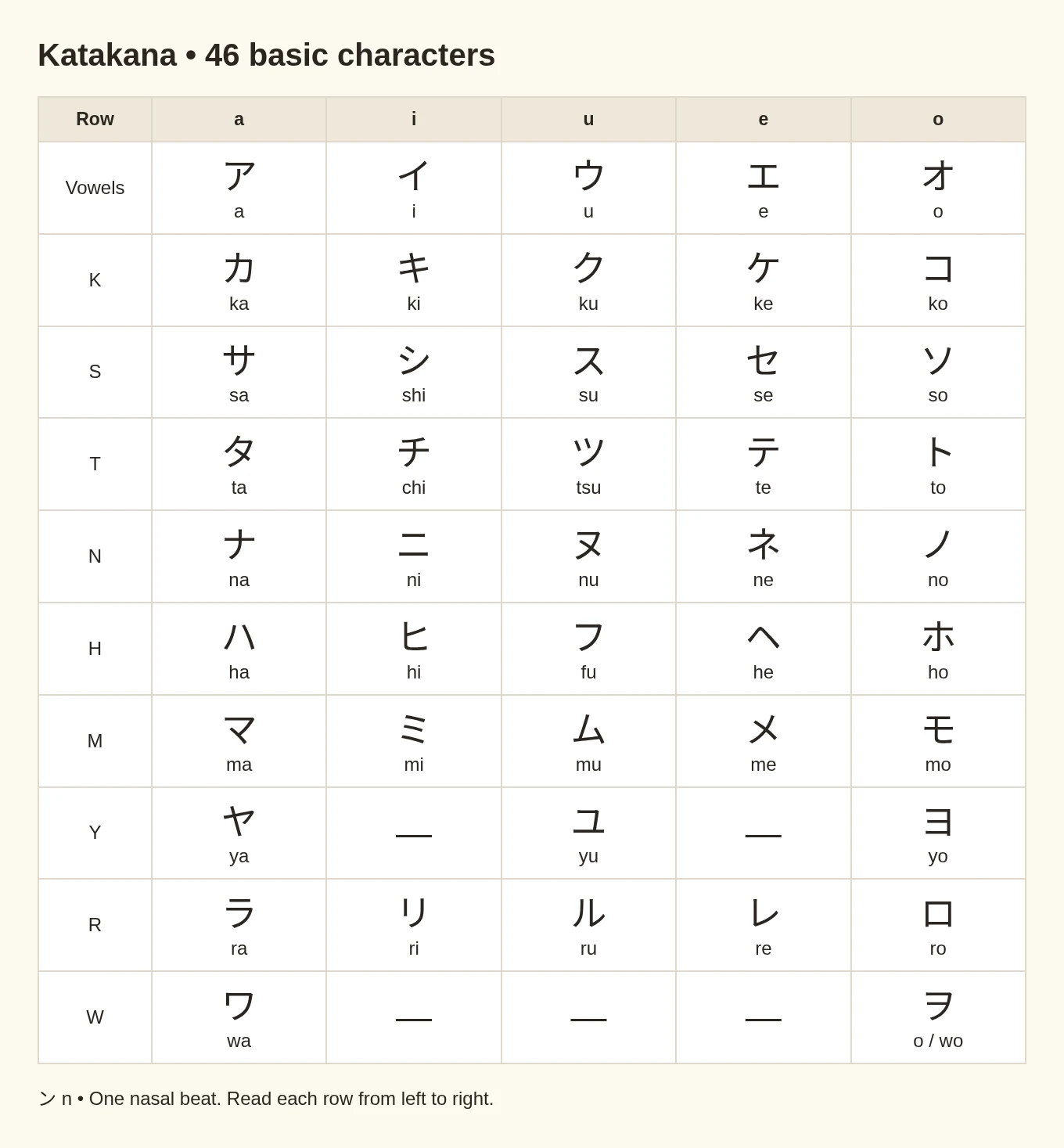
Vowels: a — ア a; i — イ i; u — ウ u; e — エ e; o — オ o
K: a — カ ka; i — キ ki; u — ク ku; e — ケ ke; o — コ ko
S: a — サ sa; i — シ shi; u — ス su; e — セ se; o — ソ so
T: a — タ ta; i — チ chi; u — ツ tsu; e — テ te; o — ト to
N: a — ナ na; i — ニ ni; u — ヌ nu; e — ネ ne; o — ノ no
H: a — ハ ha; i — ヒ hi; u — フ fu; e — ヘ he; o — ホ ho
M: a — マ ma; i — ミ mi; u — ム mu; e — メ me; o — モ mo
Y: a — ヤ ya; i — —; u — ユ yu; e — —; o — ヨ yo
R: a — ラ ra; i — リ ri; u — ル ru; e — レ re; o — ロ ro
W: a — ワ wa; i — —; u — —; e — —; o — ヲ o / wo
The final character is ン n.
The dashes mark empty positions in the modern basic chart.
You will rarely see ヲ in ordinary beginner vocabulary. The object particle is normally written with hiragana を. Recognize ヲ as part of the chart, but focus your early practice on characters that appear in everyday words.
Connect katakana to hiragana
You do not need to learn a new pronunciation system for katakana.
These pairs represent the same sounds:
あ: Katakana — ア; Reading — a
か: Katakana — カ; Reading — ka
し: Katakana — シ; Reading — shi
つ: Katakana — ツ; Reading — tsu
ね: Katakana — ネ; Reading — ne
ふ: Katakana — フ; Reading — fu
ん: Katakana — ン; Reading — n
Some pairs also look similar, such as か / カ, へ / ヘ, and り / リ. Use those connections when they help.
For less familiar shapes, connect the character directly to its sound. If you always translate カ into か before saying ka, reading will take an extra step.
Try looking at カ, saying ka, and then reading カメラ — kamera — camera.
How to pronounce katakana words
The five vowels have the same basic sounds as in hiragana:
ア a: approximately “ah.”
イ i: approximately “ee.”
ウ u: a short “oo,” with relaxed lips.
エ e: approximately the vowel in “bed.”
オ o: a pure “oh,” without the glide at the end of English “go.”
These English comparisons are starting points. Listen to Japanese pronunciation when checking a new word.
Loanwords follow Japanese sound patterns, so they may sound different from the original word.
For example:
ホテル — ho-te-ru — hotel
Read the Japanese sounds ho–te–ru. Avoid switching to the English pronunciation halfway through.
バス — ba-su — bus
The English word “bus” has one syllable. The Japanese word バス has two timing units: ba–su.
These timing units are called morae. Thinking in beats helps you notice long vowels, small ッ, and ン.
Long vowels: how to read ー
Katakana commonly uses ー, the long vowel mark, to extend the vowel before it.
It does not have one fixed sound of its own.
カード: Reading — kādo; Meaning — card; What ー extends — The a in カ
チーズ: Reading — chīzu; Meaning — cheese; What ー extends — The i in チ
スープ: Reading — sūpu; Meaning — soup; What ー extends — The u in ス
ケーキ: Reading — kēki; Meaning — cake; What ー extends — The e in ケ
コーヒー: Reading — kōhī; Meaning — coffee; What ー extends — The o in コ and the i in ヒ
Hold the vowel for an extra beat:
ケーキ = ke–e–ki
コーヒー = ko–o–hi–i
The line above a vowel in romaji, as in ā or ō, marks a long vowel. You may also see long vowels written with repeated letters, such as kaado.
Be careful not to confuse ー with 一, the kanji for “one.” In a katakana word such as スープ, it is a vowel-length mark.
Dakuten and handakuten
The two small marks in ガ are called dakuten. The circle in パ is called handakuten.
They work much as they do in hiragana.
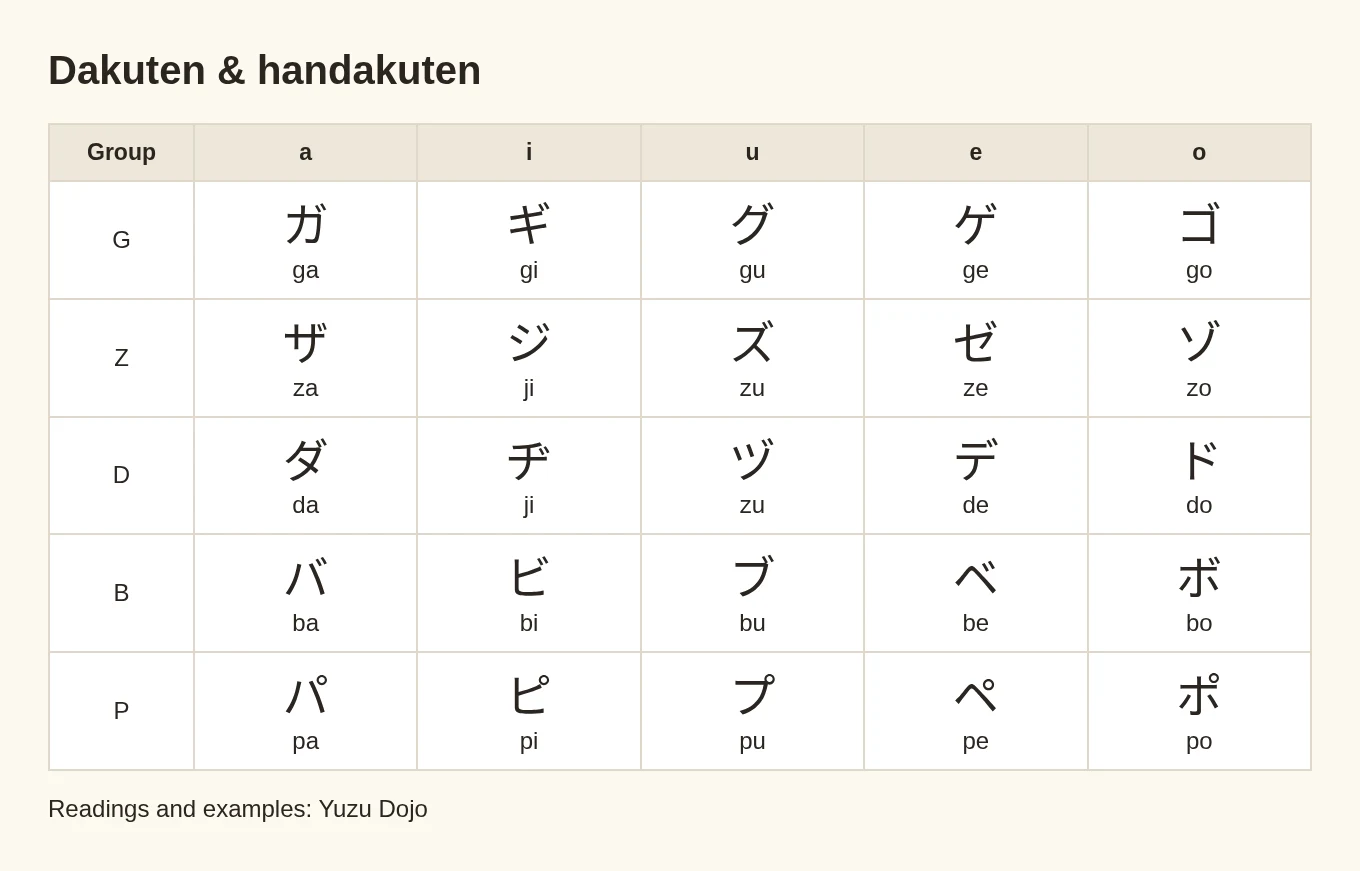
G: a — ガ ga; i — ギ gi; u — グ gu; e — ゲ ge; o — ゴ go
Z: a — ザ za; i — ジ ji; u — ズ zu; e — ゼ ze; o — ゾ zo
D: a — ダ da; i — ヂ ji; u — ヅ zu; e — デ de; o — ド do
B: a — バ ba; i — ビ bi; u — ブ bu; e — ベ be; o — ボ bo
P: a — パ pa; i — ピ pi; u — プ pu; e — ペ pe; o — ポ po
Compare:
カ → ガ: ka → ga.
ス → ズ: su → zu.
ハ → バ → パ: ha → ba → pa.
In standard modern Japanese, ヂ and ヅ usually sound like ジ and ズ. Their spellings are not interchangeable. You will meet ジ and ズ much more often in common katakana loanwords.
Try reading:
パン — pan — bread
ピザ — piza — pizza
ドア — doa — door
Small ャ, ュ, and ョ
An i-column character can combine with a small ャ, ュ, or ョ to make one beat.
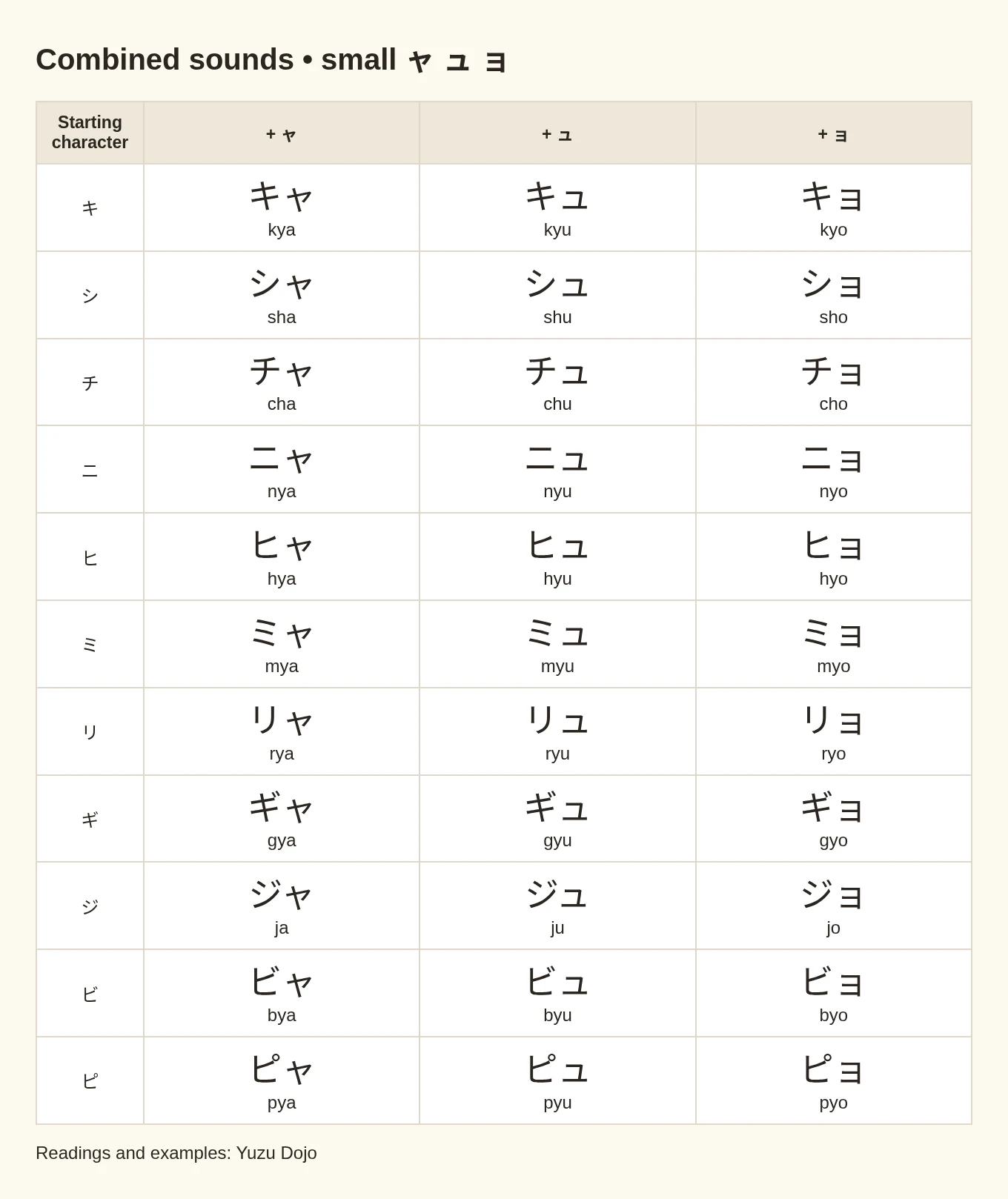
キ: + ャ — キャ kya; + ュ — キュ kyu; + ョ — キョ kyo
シ: + ャ — シャ sha; + ュ — シュ shu; + ョ — ショ sho
チ: + ャ — チャ cha; + ュ — チュ chu; + ョ — チョ cho
ニ: + ャ — ニャ nya; + ュ — ニュ nyu; + ョ — ニョ nyo
ヒ: + ャ — ヒャ hya; + ュ — ヒュ hyu; + ョ — ヒョ hyo
ミ: + ャ — ミャ mya; + ュ — ミュ myu; + ョ — ミョ myo
リ: + ャ — リャ rya; + ュ — リュ ryu; + ョ — リョ ryo
ギ: + ャ — ギャ gya; + ュ — ギュ gyu; + ョ — ギョ gyo
ジ: + ャ — ジャ ja; + ュ — ジュ ju; + ョ — ジョ jo
ビ: + ャ — ビャ bya; + ュ — ビュ byu; + ョ — ビョ byo
ピ: + ャ — ピャ pya; + ュ — ピュ pyu; + ョ — ピョ pyo
The size of the second character changes the reading:
キヤ = ki–ya: two beats.
キャ = kya: one beat.
You can see these combinations in everyday words:
シャツ — shatsu — shirt
チョコ — choko — chocolate, shortened from チョコレート
ジュース — jūsu — juice
In ジュース, ジュ is one combined beat, and ー extends its vowel: ju–u–su.
Small ッ: a hold before the next consonant
Small ッ is different from full-size ツ.
It adds a one-beat hold before the following consonant. Romaji usually shows this by doubling the consonant.
カップ — kappu — cup
Think ka–[hold]–pu. Do not say “ka-tsu-pu.”
More examples:
ベッド — beddo — bed
バッグ — baggu — bag
チケット — chiketto — ticket
For チケット, count chi–ke–[hold]–to.
When reading, check whether the character is full-size ツ or small ッ before deciding how to pronounce it.
Extra combinations you will see in loanwords
Katakana also uses small vowels to represent sounds beyond the basic chart.
You do not need to memorize every possible combination immediately. Start with these common ones:
ファ: Reading — fa; Example — ファン — fan — fan
フィ: Reading — fi; Example — フィルム — firumu — film
フェ: Reading — fe; Example — カフェ — kafe — café
フォ: Reading — fo; Example — フォーク — fōku — fork
ティ: Reading — ti; Example — パーティー — pātī — party
ディ: Reading — di; Example — ディスク — disuku — disc
チェ: Reading — che; Example — チェック — chekku — check
ウィ: Reading — wi; Example — ウィンク — winku — wink
Compare テイ and ティ:
テイ = te–i: two full-size characters.
ティ = ti: テ combines with a small ィ.
Small characters are part of the spelling, not decoration.
How to tell similar katakana apart
Some katakana are easy to confuse when you first meet them. Study these pairs together and look for one specific difference.
シ shi and ツ tsu
Both have two short marks and one longer stroke.
In standard handwriting:
シ: The short marks are more horizontal, and the long stroke rises from the lower left toward the upper right.
ツ: The short marks are more vertical, and the long stroke descends from the upper right toward the lower left.
Learning the stroke direction helps you distinguish them more reliably than counting the marks.
Practice with:
シール — shīru — sticker
ツナ — tsuna — tuna
ソ so and ン n
These each have one short mark and one long stroke.
Their long-stroke directions follow a similar contrast:
ソ: The long stroke descends from the upper right toward the lower left.
ン: The long stroke rises from the lower left toward the upper right.
Compare them in ソファ — sofa — sofa and パン — pan — bread.
Use a clear handwriting model when practicing. Fonts can make the angle differences less obvious.
ク ku and ワ wa
Look at the upper-left part.
ク begins with a short diagonal stroke.
ワ begins with a short, more vertical stroke.
Try クラス — kurasu — class and ワイン — wain — wine.
ヌ nu and ス su
Look for the crossing.
ヌ has a stroke that crosses through the main shape.
ス has a lower-right stroke without the same central crossing.
Practice ヌードル — nūdoru — noodles and スープ — sūpu — soup.
How to remember every character
Give each character a sound, a visual detail, and a word.
For example:
コ ko: Detail to notice — Two horizontal strokes joined on the right; Word — コーヒー — coffee
ト to: Detail to notice — A long vertical stroke with a short slanting stroke; Word — トマト — tomato
メ me: Detail to notice — Two crossing strokes; Word — メモ — memo
ロ ro: Detail to notice — A box shape; Word — ロボット — robot
A visual memory aid can help you recognize a character, but it should lead you back to the correct Japanese sound.
Use this practice sequence:
Learn a small group. Start with ア・イ・ウ・エ・オ, then add another row.
Mix the order. Test ウ・ア・オ・イ・エ instead of always following the chart.
Recall the shape. Look away and write a character from memory.
Read a word. Find that character inside a short word.
Review confusing pairs. Spend extra time on シ / ツ and ソ / ン.
Do some practice without hiragana or romaji beside the characters. This shows you which shapes you can recognize independently.
Read the Japanese word before guessing the English
Recognizing a familiar loanword can feel rewarding, but guessing too early can hide a reading mistake.
First, read every character. Then check the meaning.
For example:
レストラン — re-su-to-ra-n — restaurant
Notice the final ン. It has its own beat.
Also remember that a loanword’s Japanese meaning may differ from the original English word.
マンション — manshon commonly means an apartment or condominium building, rather than a large luxury house.
Learn the Japanese spelling, pronunciation, and meaning together.
Katakana reading practice
Read the following words before checking the answers. Pay attention to vowel length, small characters, and dakuten.
1: カメラ
2: ホテル
3: パン
4: タクシー
5: コーヒー
6: シャツ
7: ジュース
8: チケット
9: コンビニ
10: パーティー
Then answer these questions:
11. Which character means shi: シ or ツ?
12. What does ー do in ケーキ?
13. Do you pronounce the small ッ in カップ as tsu?
14. What is the difference between キヤ and キャ?
Answers and explanations
1: Reading — kamera; Meaning or explanation — Camera. Read ka–me–ra.
2: Reading — hoteru; Meaning or explanation — Hotel. Read the Japanese sounds ho–te–ru.
3: Reading — pan; Meaning or explanation — Bread. パ has a small circle, and ン has its own beat.
4: Reading — takushī; Meaning or explanation — Taxi. シ is shi, and ー extends its i vowel.
5: Reading — kōhī; Meaning or explanation — Coffee. Both the o and i vowels are long.
6: Reading — shatsu; Meaning or explanation — Shirt. シャ is one combined beat.
7: Reading — jūsu; Meaning or explanation — Juice. ジュ combines ジ with small ュ, then ー extends the u.
8: Reading — chiketto; Meaning or explanation — Ticket. Small ッ adds a hold before t.
9: Reading — konbini; Meaning or explanation — Convenience store. Read ko–n–bi–ni.
10: Reading — pātī; Meaning or explanation — Party. パー has a long a; ティー has a long i.
11. シ is shi. ツ is tsu.
12. It extends the e vowel: ke–e–ki.
13. No. Small ッ marks a hold before p.
14. キヤ is ki–ya, with two beats. キャ is kya, with one beat.
Common questions about learning katakana
How many katakana characters are there?
The modern basic set has 46 characters. Dakuten, handakuten, and combinations with small characters add more sound patterns without creating a completely separate basic alphabet.
Is katakana harder than hiragana?
Katakana can feel harder because several characters look similar and beginner materials may give you less practice with it. Reading short, familiar words helps you move beyond recognizing isolated characters.
Can every English word be written in katakana?
Katakana can approximate many foreign words, but Japanese has its own sound system. The result may add vowels, change consonants, or use a conventional spelling that is difficult to predict. Check how an established word is written instead of converting it letter by letter.
Should I memorize the whole chart before reading words?
No. Start reading words as soon as you know enough characters. カメラ, ホテル, and トマト give you useful practice without requiring long vowels or small characters.
What should I practice after the basic chart?
Practice words containing ー, ッ, and small ャ・ュ・ョ, then add combinations such as ティ and ファ. Menus, food packaging, and station signs give you opportunities to recognize katakana in context.
Ready to practice katakana? From Yuzu Dojo 2.1.0, hiragana and katakana have no daily new-card limit on the Free plan. Try a few cards, check the reading and example word, then revisit the characters you want to remember. No subscription or ad viewing is required for kana practice.