Japanese basics
Hiragana Chart for Beginners: Stroke Order, Pronunciation, and Practice
Learn the 46 basic hiragana with a beginner-friendly chart, pronunciation tips, stroke-order basics, and reading practice with answers.
Hiragana is one of the first writing systems you will learn in Japanese. Its curved characters appear in everyday words, grammar endings, and the small reading guides printed above kanji.
Start with the 46 basic characters in the hiragana chart below. Then learn how small marks change their sounds, practice writing a few simple characters, and test yourself with real Japanese words.
You do not need to memorize the whole chart before you begin reading. Even a handful of characters lets you read your first words.
What is hiragana?
Japanese uses three main writing systems: hiragana, katakana, and kanji.
Hiragana represents sounds. For example, あ represents a, and か represents ka. Most basic hiragana represent either a vowel or a consonant followed by a vowel. The character ん is different: it represents a nasal sound.
You will see hiragana in:
Words such as ねこ (neko, “cat”), which can be written in hiragana.
Grammatical particles such as は, が, and を.
Verb endings, such as べる in 食べる (taberu, “to eat”).
Furigana: small characters that show how to read kanji.
The Latin-letter spellings in this guide are called romaji. Use them to check a reading, then try looking at the hiragana alone.
Hiragana chart: the 46 basic characters
Read each row from left to right. The columns follow the vowel order a, i, u, e, o.
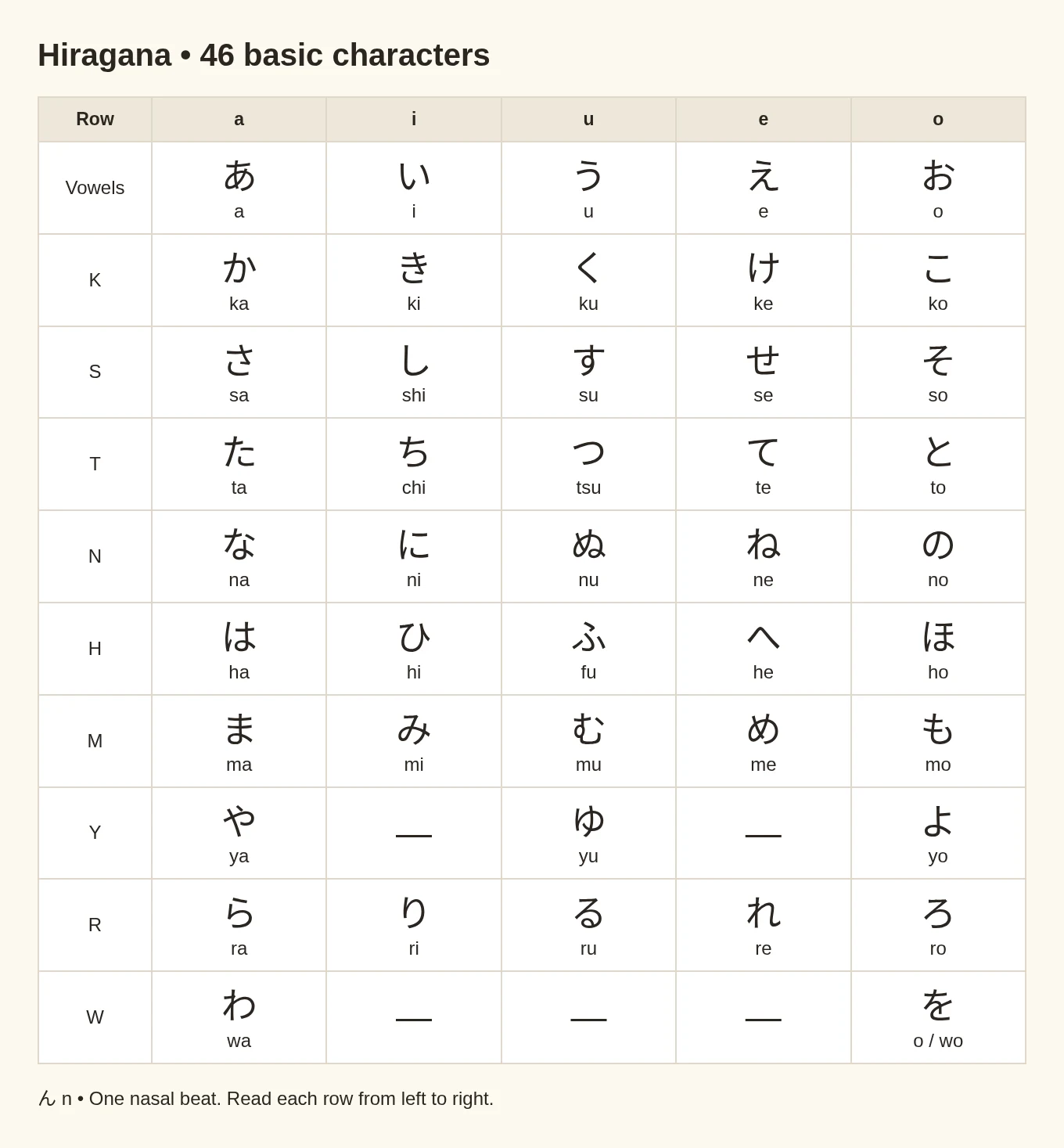
Vowels: a — あ a; i — い i; u — う u; e — え e; o — お o
K: a — か ka; i — き ki; u — く ku; e — け ke; o — こ ko
S: a — さ sa; i — し shi; u — す su; e — せ se; o — そ so
T: a — た ta; i — ち chi; u — つ tsu; e — て te; o — と to
N: a — な na; i — に ni; u — ぬ nu; e — ね ne; o — の no
H: a — は ha; i — ひ hi; u — ふ fu; e — へ he; o — ほ ho
M: a — ま ma; i — み mi; u — む mu; e — め me; o — も mo
Y: a — や ya; i — —; u — ゆ yu; e — —; o — よ yo
R: a — ら ra; i — り ri; u — る ru; e — れ re; o — ろ ro
W: a — わ wa; i — —; u — —; e — —; o — を o / wo
The final character is ん n.
The dashes mark empty positions in this modern basic chart. You do not need to learn an extra character for each blank.
Notice these readings:
し is shi, rather than “si” in the romaji used here.
ち is chi.
つ is tsu.
ふ is written fu, though its Japanese sound differs from English “foo.”
を is usually pronounced o when used as a particle. You may see it written as wo in romaji.
How to pronounce hiragana
Start with the five vowels. The English comparisons below are approximate; they help you get started but do not reproduce Japanese pronunciation exactly.
あ a: “ah,” as in “father”
い i: “ee,” as in “see”
う u: A short “oo,” with relaxed lips rather than strongly rounded lips
え e: “e,” as in “bed”
お o: A pure “oh,” without the glide at the end of English “go”
Keep the vowels clear and avoid adding strong English-style stress.
For example:
ねこ — ne-ko — cat
Say the two parts with roughly even timing, rather than strongly stressing “NEH.”
A few sounds deserve extra attention:
ふ fu: Bring your lips near each other and gently blow air through them. Your upper teeth should not press against your lower lip as they do for an English “f.”
ら・り・る・れ・ろ: The Japanese “r” usually uses a quick tongue tap near the ridge behind your upper teeth. Avoid holding an English “r.”
ん n: This sound has its own beat. In ほん (hon, “book”), count ho–n. Its exact pronunciation changes depending on the sound that follows.
Why は, へ, and を sometimes sound different
Three characters have special readings when they work as grammatical particles.
は: Usual chart reading — ha; Particle reading — wa
へ: Usual chart reading — he; Particle reading — e
を: Usual chart reading — Usually shown as wo or o; Particle reading — o
わたしは がくせいです。
Watashi wa gakusei desu.
I am a student.
Here, は marks the topic, so you read it as wa.
えきへ いきます。
Eki e ikimasu.
I am going to the station.
Here, へ marks direction, so you read it as e.
みずを のみます。
Mizu o nomimasu.
I drink water.
Here, を marks the object and is pronounced o.
The spaces in these examples help you see the word groups. Ordinary Japanese writing generally does not put spaces between words.
Hiragana stroke order: start with simple characters
Stroke order is the sequence of movements you use to write a character. A stroke continues until you lift your pen.
Two useful starting principles are:
Many characters begin near the top and move downward.
Separate parts are often written from left to right.
These are general tendencies, not rules that let you predict every character. Learn the actual sequence for each new hiragana.
Try these three simple characters first:
く ku: Strokes — 1; How to write it — Start at the upper right, move diagonally down-left, then turn and move diagonally down-right without lifting your pen.
こ ko: Strokes — 2; How to write it — Write the upper stroke from left to right, then the lower curved stroke from left to right.
い i: Strokes — 2; How to write it — Write the longer left stroke downward, finishing with a small upward flick. Lift your pen and write the shorter right stroke downward.
Practice each character with this sequence:
Look carefully at its shape and stroke order.
Write it slowly while saying its sound.
Cover the model and write it again from memory.
Compare the two and correct one detail.
Printed and handwritten hiragana can look different. In particular, き and さ often have a separate lower stroke in handwriting, even when a font makes the shape look connected.
Your goal is a recognizable character with the right proportions. You do not need to imitate every curve of a digital font.
Dakuten and handakuten: small marks that change sounds
The two small marks in が are called dakuten. They change the sound of certain hiragana.
The small circle in ぱ is called handakuten.
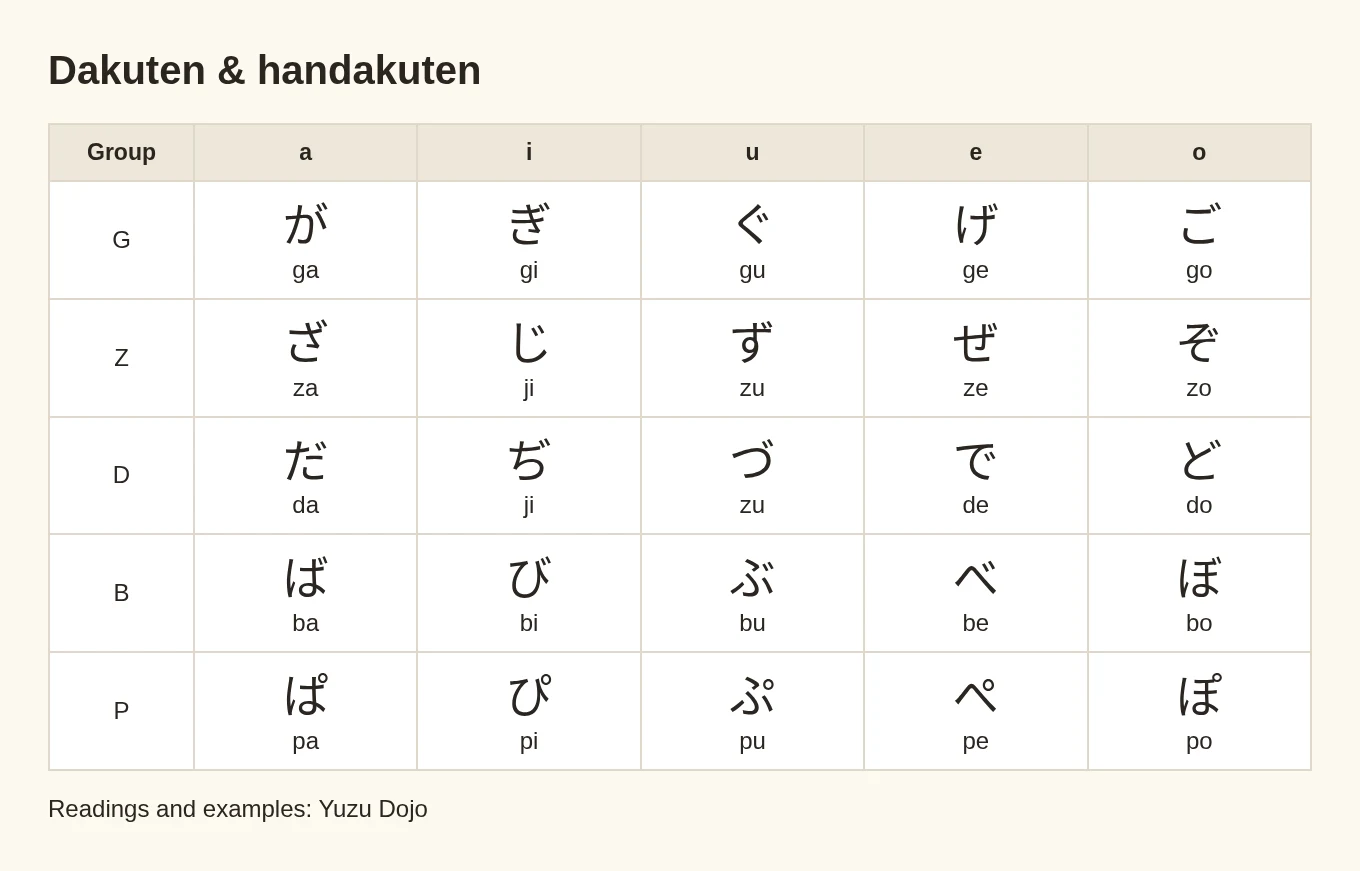
G: a — が ga; i — ぎ gi; u — ぐ gu; e — げ ge; o — ご go
Z: a — ざ za; i — じ ji; u — ず zu; e — ぜ ze; o — ぞ zo
D: a — だ da; i — ぢ ji; u — づ zu; e — で de; o — ど do
B: a — ば ba; i — び bi; u — ぶ bu; e — べ be; o — ぼ bo
P: a — ぱ pa; i — ぴ pi; u — ぷ pu; e — ぺ pe; o — ぽ po
For example:
か → が: ka → ga
す → ず: su → zu
は → ば → ぱ: ha → ba → pa
In standard modern Japanese, ぢ and づ usually sound like じ and ず. Their spellings are not interchangeable, so learn them as part of words.
Try reading:
かぎ — kagi — key
みず — mizu — water
ぶた — buta — pig
Small ゃ, ゅ, and ょ: combined sounds
An i-column character can combine with a small ゃ, ゅ, or ょ.
Read the pair as one beat:
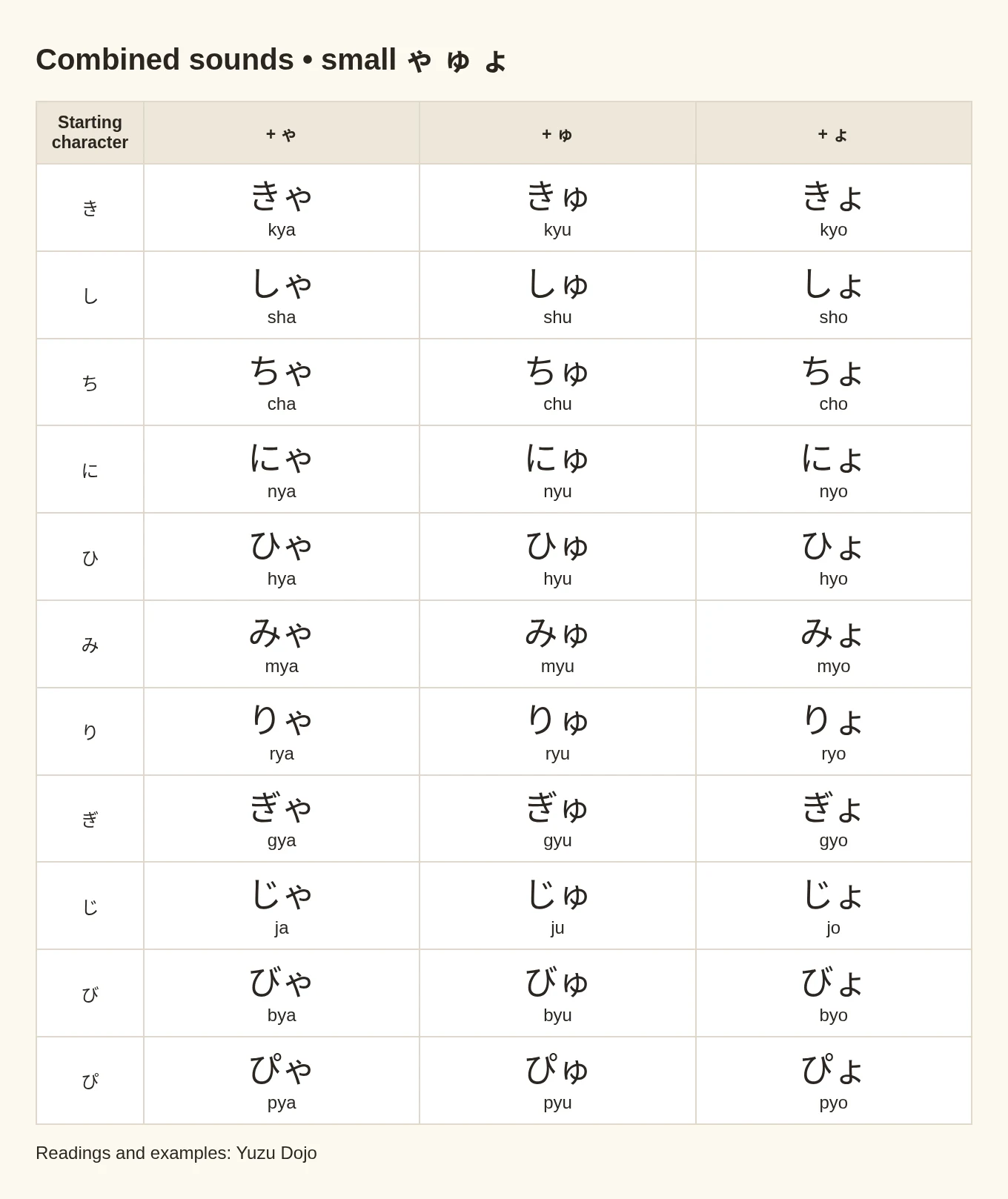
き: + ゃ — きゃ kya; + ゅ — きゅ kyu; + ょ — きょ kyo
し: + ゃ — しゃ sha; + ゅ — しゅ shu; + ょ — しょ sho
ち: + ゃ — ちゃ cha; + ゅ — ちゅ chu; + ょ — ちょ cho
に: + ゃ — にゃ nya; + ゅ — にゅ nyu; + ょ — にょ nyo
ひ: + ゃ — ひゃ hya; + ゅ — ひゅ hyu; + ょ — ひょ hyo
み: + ゃ — みゃ mya; + ゅ — みゅ myu; + ょ — みょ myo
り: + ゃ — りゃ rya; + ゅ — りゅ ryu; + ょ — りょ ryo
ぎ: + ゃ — ぎゃ gya; + ゅ — ぎゅ gyu; + ょ — ぎょ gyo
じ: + ゃ — じゃ ja; + ゅ — じゅ ju; + ょ — じょ jo
び: + ゃ — びゃ bya; + ゅ — びゅ byu; + ょ — びょ byo
ぴ: + ゃ — ぴゃ pya; + ゅ — ぴゅ pyu; + ょ — ぴょ pyo
The size of the second character matters:
きや = ki-ya: two beats.
きゃ = kya: one beat.
For example, ひゃく (hyaku, “one hundred”) has two beats: hya–ku.
Small っ: hold the next consonant
Small っ is different from full-size つ.
It marks a one-beat hold before the following consonant. In romaji, this is commonly shown by doubling that consonant.
きって — kitte — postage stamp
Think ki–[hold]–te. Do not pronounce a separate “tsu.”
Compare:
きて — kite: come, as a request.
きって — kitte: postage stamp.
That extra beat changes the word.
Long vowels: give the sound enough time
Vowel length also matters in Japanese. A long vowel lasts for two beats instead of one.
Compare:
おばさん — obasan: aunt.
おばあさん — obaasan: grandmother.
The extra あ makes the vowel longer.
You will also meet long vowels written with other combinations:
おかあさん — okaasan — mother: hold the a.
おにいさん — oniisan — older brother: hold the i.
くうき — kūki — air: hold the u.
とけい — tokei — clock: えい is commonly pronounced like a long e.
がっこう — gakkō — school: おう represents a long o here.
Some long o sounds are written おお, as in おおきい (ōkii, “big”). Learn the spelling with each word.
The line above a vowel in ū or ō marks a long vowel. Other romaji systems may write these as uu or ou.
How to practice with a hiragana chart
Use the chart to check your memory, then spend some time with it covered.
Start with the vowel row. Add a few characters at a time, and mix new characters with ones you already know.
A short practice session can include:
Recognition: Look at five characters in a mixed order and say their sounds.
Recall: Look away and write those characters from memory.
Reading: Read two or three words that use them.
Correction: Check the chart and repeat the characters you confused.
Practice outside chart order. Knowing that く comes after き is different from recognizing く immediately inside a word.
Pay particular attention to similar shapes:
あ / お
ぬ / め
ね / れ / わ
る / ろ
For ぬ and め, notice the small loop at the end of ぬ. For る and ろ, look for the lower loop in る.
Hiragana reading practice
Read each item before looking at the answers. You can use the chart for the first attempt, then try again without it.
1: あお
2: いえ
3: ねこ
4: すし
5: みず
6: かぎ
7: ひゃく
8: きって
9: がっこう
10: おかあさん
Then answer these three questions:
11. How do you pronounce は in わたしは?
12. What is the difference between きや and きゃ?
13. Do you pronounce the small っ in きって as “tsu”?
Answers and explanations
1: Reading — ao; Meaning or explanation — Blue; read both vowels: a–o.
2: Reading — ie; Meaning or explanation — House; read i–e.
3: Reading — neko; Meaning or explanation — Cat.
4: Reading — sushi; Meaning or explanation — Sushi; し is shi.
5: Reading — mizu; Meaning or explanation — Water; dakuten changes す to ず.
6: Reading — kagi; Meaning or explanation — Key; dakuten changes か to が.
7: Reading — hyaku; Meaning or explanation — One hundred; ひゃ is one combined beat.
8: Reading — kitte; Meaning or explanation — Postage stamp; small っ adds a hold before t.
9: Reading — gakkō; Meaning or explanation — School; small っ adds a hold before k, and こう has a long o.
10: Reading — okaasan; Meaning or explanation — Mother; the あ after か lengthens the a sound.
11. Wa. Here, は is the topic particle.
12. きや is ki-ya, with two beats. きゃ is kya, with one beat.
13. No. Small っ marks a hold before the following consonant.
Common questions about learning hiragana
How many hiragana characters are there?
The modern basic set contains 46 characters. Voiced forms such as が and combinations such as きゃ build on that set, so a more detailed chart will show additional entries.
Should I learn hiragana or katakana first?
Hiragana is a practical starting point because it appears throughout basic Japanese grammar and beginner reading materials. Katakana uses many of the same sounds with different shapes, so learning it afterward lets you build on familiar pronunciation.
Do I need to write hiragana by hand?
You can practice reading without mastering handwriting first. Writing can still help you notice differences between similar characters. A useful starting point is to recognize a character, say its sound, and write it slowly from a model.
When can I stop using romaji?
Begin hiding romaji as soon as you recognize a few characters. Try reading the hiragana first and use romaji only to check. You do not need to wait until you know the entire chart.
What should I practice after the basic chart?
Work on dakuten, small ゃ・ゅ・ょ, small っ, and long vowels. Then read short words and sentences that combine them. Revisit the practice above until you can explain why ひゃく, きって, and がっこう are read differently.
Ready to practice hiragana? From Yuzu Dojo 2.1.0, hiragana and katakana have no daily new-card limit on the Free plan. Try a few cards, check the reading and example word, then revisit the characters you want to remember. No subscription or ad viewing is required for kana practice.